
Investigation Report Example (+Free Template)
See a real investigation report example, download a free template, and learn how to write a report that holds up to even the toughest legal scrutiny.


.webp)
Every investigation ends the same way: as a report. All the interviews, the surveillance footage, the case notes, the evidence you tracked down over weeks or months…eventually, it all has to be put together.
And the reality is that your report is often the only part of your work anyone outside the case will ever read. So if it's disorganized, vague, or missing pieces, it won't matter how thorough the investigation itself was. That's all that will be remembered.
This guide walks through what belongs in an investigation report, shows a real investigation report example, and includes a free investigation report template you can start using today.
What Is An Investigation Report?
An investigation report is a written record of what happened during an investigation, what evidence supports it, and what conclusions the investigator reached. It turns hours of interviews, evidence review, and analysis into something a manager, attorney, judge, or client can actually read and trust.
Whether you're investigating a workplace misconduct complaint, an insurance claim, or a criminal case, the goal is the same: lay out the facts clearly enough that someone who wasn't there can follow exactly what happened and why you reached your conclusion.
Elements Of An Effective Investigation Report
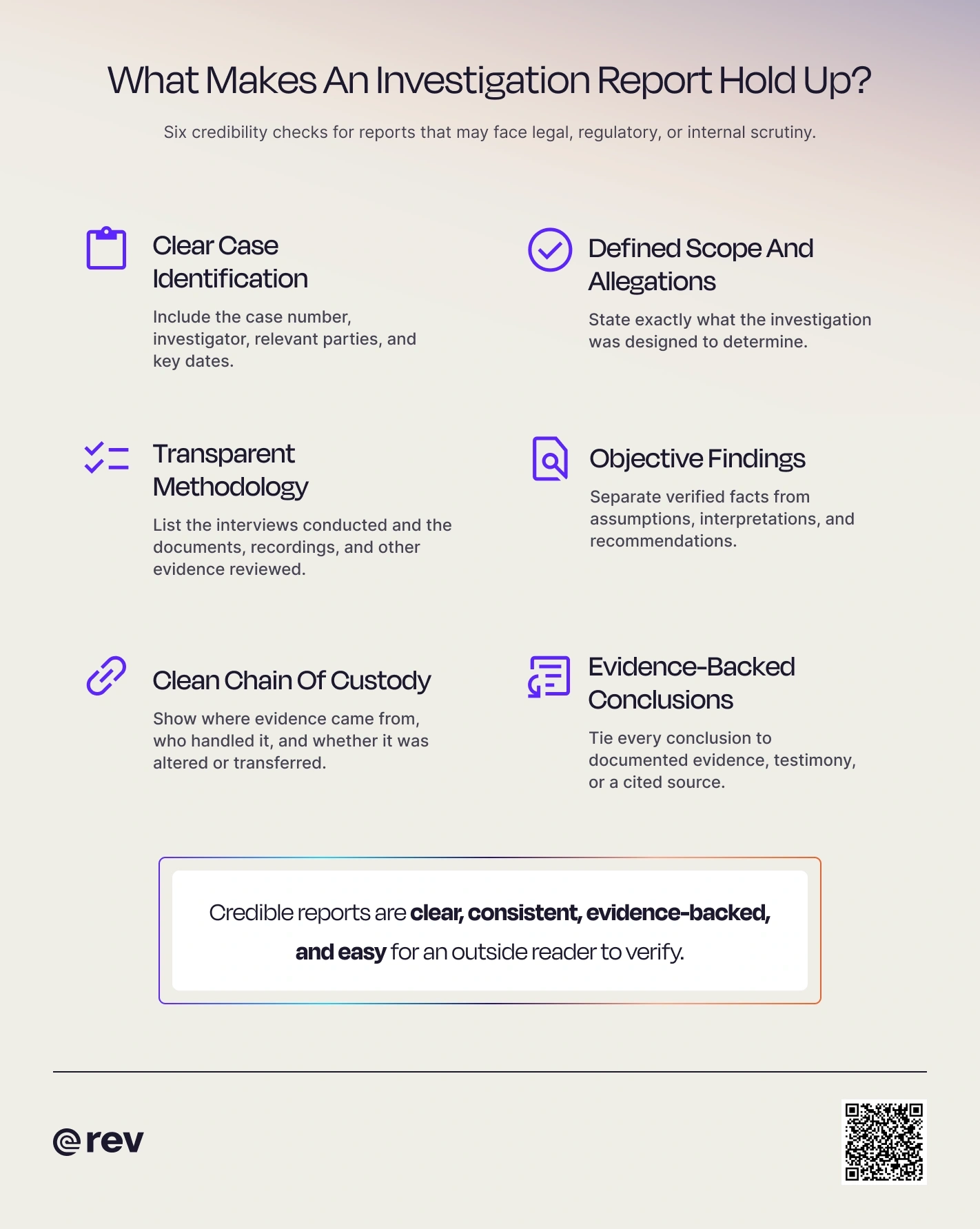
Every solid investigation report includes a few core elements, no matter the industry. Skip one, and the report starts to look incomplete (or worse, unreliable).
- Case Identification: names, dates, case number, and who conducted the investigation.
- Scope & Allegations: what the investigation was meant to answer.
- Methodology: how evidence was gathered, including which interviews and materials were reviewed.
- Findings: what the evidence actually shows, presented objectively and without opinion.
- Chain Of Custody: Show where evidence came from, who handled it, and whether it was altered or transferred.
- Conclusion & Recommendations: what the findings mean and what should happen next.
Some investigators write all of this into one continuous document. Others separate it into an investigation plan at the start of the case and a findings report at the end, with a short investigation summary up top for anyone who needs the highlights. Either approach works, as long as every element above shows up somewhere in the final file.
If you plan to work with a private investigator to create the report, the same rules apply.
"I believe every attorney should at least have a working relationship with a PI they trust, and if one can be afforded, have them on retainer for every case," notes Jerry Garner, attorney at Law Office of Jerry L. Garner.
"PIs are able to piece together the investigation that should have been carried out by the police before charging the accused. And oftentimes, a PI uncovers exculpatory evidence that would've never been found without them."
How To Create An Investigation Report In 6 Steps
Every type of case follows some version of the same investigation process, whether it wraps up in a day or drags on for a year. Here's how to move through it step by step.
1. Confirm Scope
Before you open a single file, write down exactly what you're investigating: the allegation, everyone involved, and the types of evidence you expect to need. This becomes your investigation plan, and it's worth putting in writing even for small cases, since it gives you something to point back to later if any questions arise.
It's also important to keep an eye out for scope creep. New details almost always surface once you start pulling threads, and it's tempting to chase every one of them. If something outside the original scope looks serious, note it and flag it separately rather than letting it quietly expand the case you're supposed to be closing.
2. Collect Evidence
Gather everything relevant: documents, emails, video, physical evidence, and recordings. This is where things can get messy. Body cam footage, recorded interviews, and surveillance videos pile up quickly, and reviewing all of it by hand can eat up days you don't have. Flag anything time-sensitive first, like footage that's set to be overwritten or lives within a system that only retains logs for a set number of days.
As you collect, label, and date everything, keep a simple log of where each piece came from and when you got it. This matters more than it seems like it should in the moment. If your findings ever get challenged, being able to show a clean chain of custody is often what separates a report that holds up from one that doesn't.
"The main challenge is that digital evidence is easy to copy, move, and change without leaving obvious signs," said David Jones, Director at Reveal Private Investigations.
"A single case can involve CCTV footage, phone extractions, cloud data, vehicle records, and platform logs, all of which behave differently and store information in different ways…This is why careful logging, consistent naming, and strong record-keeping have become so important."
3. Conduct Interviews
Talk to everyone with relevant knowledge — the complainant, the subject, and any witnesses — generally in that order. Record every interview you're allowed to, and get a transcript created for easy analysis. A transcript that syncs to your recording protects you if someone later disputes what they said, and it gives you something to check instead of relying on memory or handwritten notes.
During these investigation interviews, ask open-ended questions and let people tell their account in their own words before you press for detail. Leading questions can taint an otherwise solid interview and give the other side an easy way to challenge your findings later. If someone refuses to be interviewed or can't be reached, document that too — who they are, when you tried, and why the interview didn't happen.
4. Analyze Evidence
Compare what people said against each other and against the physical evidence. Look for contradictions, gaps, and corroboration. A lot of cases are decided during this step, since the strength of your conclusion depends entirely on how carefully you did this step.
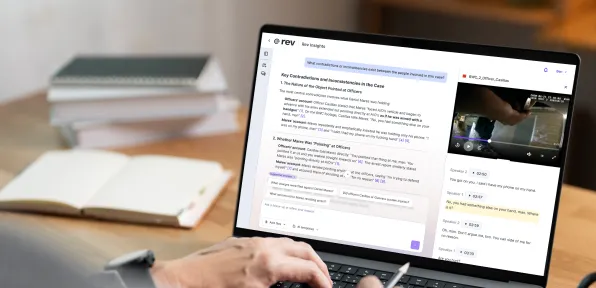
Luckily, private investigator software is here to help. Tools like Rev allow you to analyze all your evidence (no matter the type) at once, and it even surfaces contradictions for you to review. You can easily share clips of the moments that matter, interrogate your evidence like you would a witness, and create a timeline of events that will hold up in court.
Resist the urge to stop analyzing the moment you find evidence that supports the version of events you expected going in. A thorough analysis looks hard at anything that contradicts the obvious conclusion too, since that's exactly what a skeptical reader will look for.
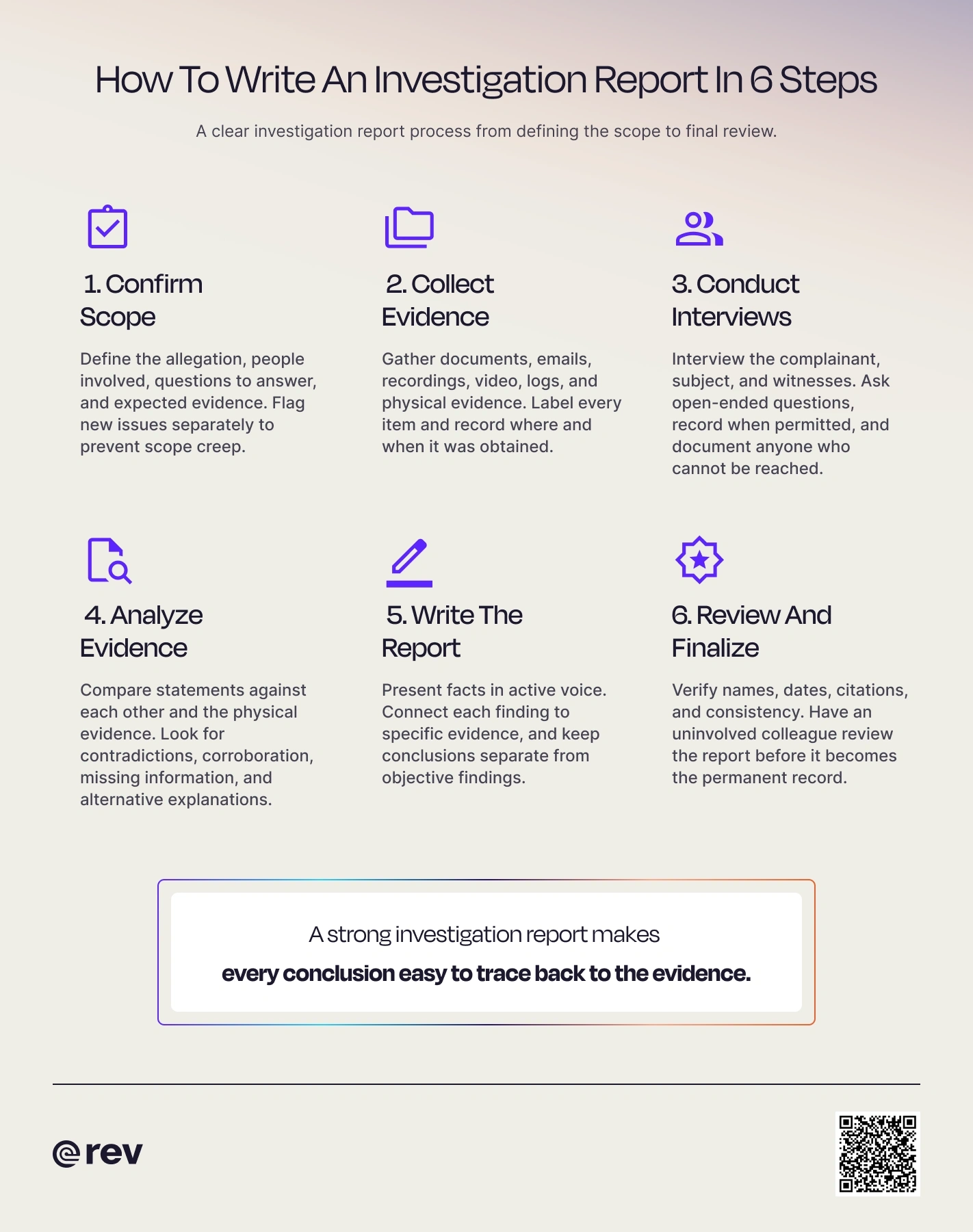
5. Write The Report
Now put it together using your investigation report template. Stick to facts, not opinions, and write in an active voice — "I reviewed the footage" rather than "the footage was reviewed." Present each finding alongside the specific evidence that supports it, so a reader never has to take your word for something without seeing what it's based on.
Save your interpretation and recommendations for the conclusion section, not the findings section. Blending fact and opinion is one of the most common reasons a report loses credibility, because it becomes hard to tell what actually happened versus what the investigator assumed.
6. Review And Finalize
Read the report as if you're the person questioning it hardest. Are the facts consistent from section to section? Does every conclusion trace back to evidence that's actually documented earlier in the report? Check spelling, names, and dates carefully — small errors are an easy way for a challenge to gain traction on an otherwise strong report.
Have a colleague review it before it's final, ideally someone who wasn't involved in the case and can catch gaps you're too close to see. Once the report is finished and distributed, treat it as a permanent record. It's often the only account of the investigation anyone will ever refer back to.
Free Template + Example
Staring at a blank page is the hardest part of writing any report. Here's a short investigation report example of what a finished report can look like:
Case No. 2026-0143
Investigator: J. Alvarez
Scope: Complaint of policy violation filed 3/2/2026 by warehouse associate S. Chen against shift lead R. Torres.
Methodology: Reviewed badge access logs and security footage; interviewed complainant, subject, and two witnesses.
Findings: Witness statements corroborate the complainant's timeline. Security footage confirms the subject's presence at the location during the reported incident.
Conclusion: Allegation substantiated. Recommend disciplinary review per company policy.
Whether you need a template for a workplace case, an insurance claim, or a private investigation case, ours is built to adapt. Download the free investigation report template below, and use it as a sample investigation report template for whatever case type lands on your desk next.
Reasons To Create An Investigative Report
A good investigation report does more than close out a case file. It protects the organization or agency if the decision is challenged later — in an appeal, a lawsuit, or an internal audit. Without a clear written record, you're relying on memory months or years after the fact, and memory doesn't hold up well against a well-prepared opposing counsel.
It also builds consistency. When every investigator on a team uses the same structured format, cases become easier to compare, easier to hand off mid-investigation, and easier for leadership to review at a glance.
And a well-written report protects the people involved. Findings that are clearly backed by evidence are harder to dismiss as biased or incomplete — for the person who filed the complaint and the person accused.
Benefits Of Investigation Tools
Writing an investigation report used to mean listening back through hours of recordings, typing notes by hand, and crossing your fingers that nothing got missed along the way. But now, AI transcription and analysis tools can turn interviews and body cam footage into searchable, timestamped transcripts, and case management software can help track ongoing cases across a team. Both are cutting time out of the reporting process.
Rev is built specifically for this kind of work: it turns interviews, body cam footage, and case recordings into investigative transcripts with every citation tied back to a timestamp in the original file, so nothing in your report ever gets pulled out of context. Pre-built report templates inside the platform can also flag inconsistencies across statements automatically, before you even start drafting.
U.S. ISS Agency, a private investigation firm, used Rev to cut transcript review time from hours to minutes and reduce costs per case — all while meeting the accuracy their clients require. Here's what the president, Ken Miller, had to say about us:
"Moving to Rev was a crucial part of creating a cost efficient and time efficient model for our clients and our organization itself. The final product from Rev is accurate and it's exceptionally well done... It saves our clients thousands of dollars in terms of doing transcripts."
For any investigator juggling multiple open cases, that kind of time back is often the difference between a report that ships on schedule and one that doesn't.
Write Reports That Hold Up
A strong investigation report is built one clear, evidence-backed finding at a time. Start with the free template above, follow a consistent investigation process, and use the tools available to clear out the busywork so your time goes toward the parts of the case that actually need your judgment.


.webp)
.webp)
.webp)