Chain Of Custody & Multimedia Evidence Guide
As digital evidence multiplies, so does the paperwork trail required to keep it admissible. Check out our guide to maintaining chain of custody.


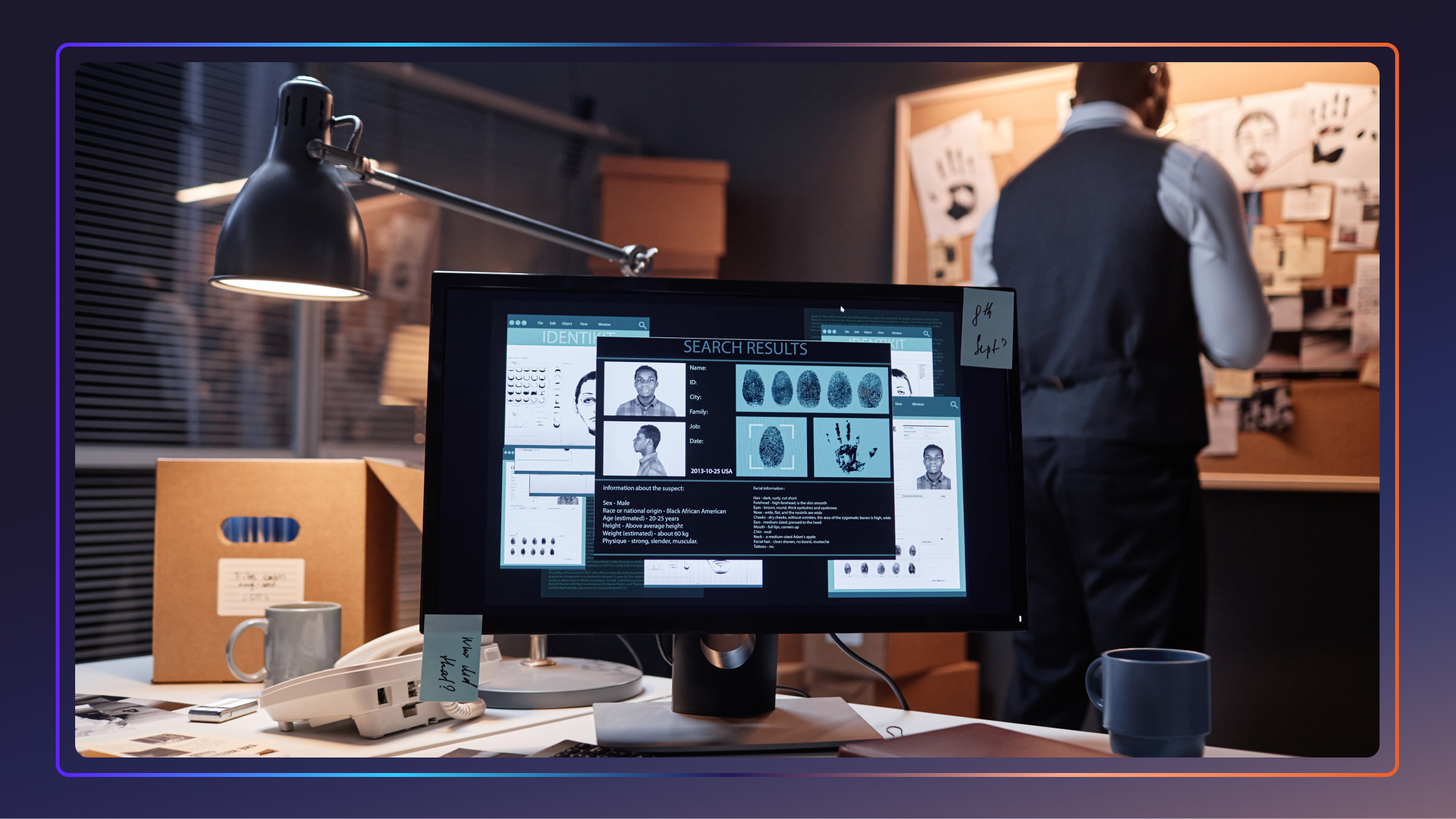
A detective pulls up body cam footage from a domestic disturbance call six months ago. The clip shows exactly what she needs: a clear admission, caught on camera, that could make or break the case. But when the file lands in front of the prosecutor, there's a problem.
Nobody can say for certain who last accessed the footage, or whether it was copied, converted, or stored the same way it was captured. That chain of custody gap is enough for the defense to challenge the credibility of the video under Federal Rules of Evidence 901.
This scenario plays out more than most investigators would like to admit. As digital evidence multiplies, so does the paperwork trail required to keep it usable in court. Here's what you need to know about maintaining chain of custody, why it’s become more complicated with today's evidence, and what you can do to keep it airtight.
What Is Chain Of Custody?
Chain of custody is the documented, unbroken record of who collected a piece of evidence, who handled it after that, and what happened to it (and why) at every step in between. And while there is no outright "chain of custody" rule, its purpose is to prove the authenticity of evidence and meet the FRE 901 requirement for authentication.
In plain terms: it's the paper or digital trail that proves the evidence in the courtroom is the same evidence collected at the scene, untouched and unaltered along the way. You'll sometimes hear it called the chain of evidence or chain of possession — different names for the same underlying idea. Also, keep in mind that while this is a federal guideline, most states have adopted these rules of evidence into their own charters.
Why Maintaining A Proper Chain Of Custody Matters
A chain of custody isn't just busy work. It's what gives evidence its credibility. Without it, there's no way to confirm that a piece of evidence wasn't lost, swapped, or tampered with somewhere between the scene and the courtroom.
That matters more today than it used to, as video is now central to how cases get built and argued (think bodycam, doorbell, security, and cell footage). More than half of today's cases involve over 50 hours of video or audio evidence. In addition, 44% of legal professionals say that scrubbing through audio/video in real time is their biggest time drain.
Every one of those files needs its own documented history as part of a broader digital evidence management strategy. Miss one, and the whole case can be at risk.
How Chain Of Custody Is Commonly Used
Chain of custody shows up anywhere evidence needs to hold up to scrutiny, and the documentation looks a little different depending on who's collecting it and what type of evidence it is.
- Law enforcement officers and evidence technicians log physical items at the scene such as firearms, drugs, biological samples, and seized devices.
- Prosecutors and defense attorneys rely on this documentation to argue for or against admissibility.
- Forensic scientists add their own layer of documentation, tracking every test and analysis performed on a sample so results can't be challenged.
- Insurance fraud investigators and internal affairs teams follow similar principles for recorded statements and surveillance footage that may end up in litigation.
- Journalists and researchers keep records of where source recordings came from so their reporting can be verified later.
The common thread: whoever ends up relying on a piece of evidence needs to trust where it's been. And remember, under FRE 902, some documents (like public records) are self-authenticating and don’t require extra evidence.
What Breaks Chain Of Custody?
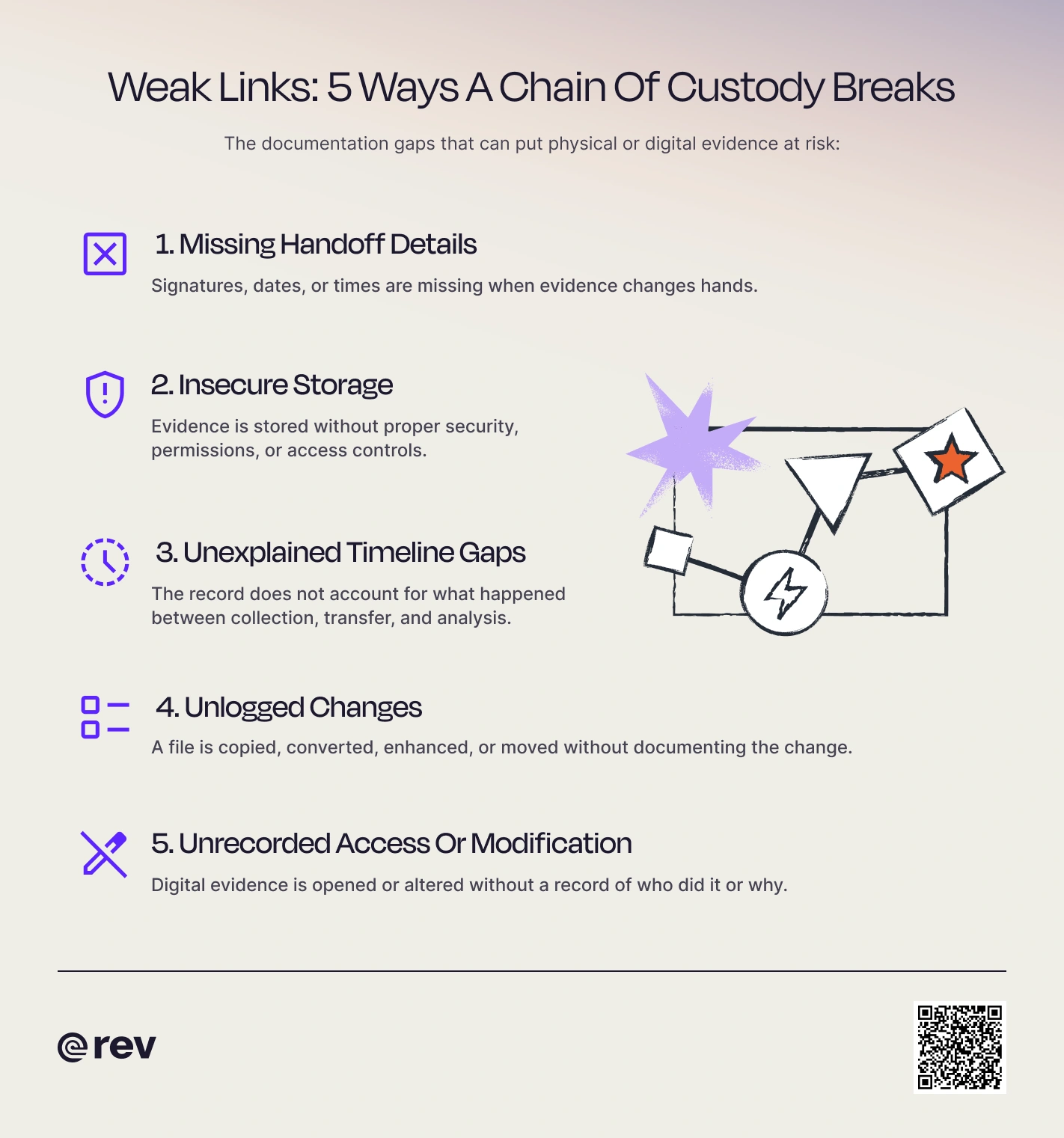
A chain of custody breaks any time there's a gap or inconsistency in the documented history of the digital or physical evidence. Common culprits that break chain of custody include:
- Missing signatures, dates, and times when evidence changes hands
- Evidence stored without proper security or access controls
- Unexplained gaps in the timeline between collection and analysis
- Copies, conversions, or transfers that aren't logged
- Digital evidence that's accessed or modified without a record of who did it or why
Digital chain of custody raises its own version of this problem. Merely opening a file can alter its metadata, and without a way to verify a file hasn't changed since it was collected, the defense has grounds to question it.
What Happens If You Break The Chain Of Custody?
A broken chain of custody doesn't automatically mean evidence disappears from a case. Courts weigh how serious the gap is. Minor issues might just affect how much weight a jury gives the evidence. But significant breaks can lead to a motion to suppress, and if granted, that evidence never reaches the jury at all.
Courts have excluded evidence for exactly this reason. Photos and profiles pulled from social media have been ruled inadmissible under FRE 901 when there was no way to authenticate them, including in People v. Lenihan. The same standard applies to video and audio: if it can't be authenticated, it doesn't matter how compelling it looks.
For a prosecutor, that can mean losing the piece of evidence a case was built around. For a defense attorney, it can be the opening that gets a client's charges reduced or dismissed. Either way, chain of custody problems are one of the most common evidentiary issues that can reshape a case before it ever reaches trial.
The Chain of Custody Process + Needed Documentation
Every piece of evidence should move through a version of the same basic process, whether it's a physical item or a digital file.
1. Collection
The chain starts the moment evidence is collected, and it's initiated by whoever collects it — usually the first officer or investigator on scene, or the analyst who pulls a recording from a source device. That means recording who collected it, exactly when and where, and under what circumstances.
For digital files, this includes noting the source device, the original file format, and any hash value used to verify the file hasn't been altered since. Skipping this step makes everything downstream harder to defend.
2. Documentation & Labeling
Every item gets a unique identifier tied to the case, logged on a chain of custody form along with a description detailed enough that anyone reviewing the record later can confirm it's the same piece of evidence. For video and audio files, that includes digital data like file names, formats, durations, and where the original is stored.
We spoke to David Jones, Director at Reveal Private Investigations, who explained this step in more detail:
“Each item should be given a unique reference number as soon as it is collected. Where possible, a digital fingerprint of the file should be created at the point of collection so it can be checked later to confirm it has not changed. Every time the file is moved, opened, or processed, that activity should be logged, including who handled it, when, why, and where it was stored.
Original files should always be preserved in their original form and kept separate from any working copies used for analysis. If any changes are made for clarity, such as enhancing video or converting formats, those steps need to be fully recorded so the process can be repeated if needed. The key question the documentation must always answer is simple: is this still the same file that was originally collected, and can we prove it.”
3. Storage & Transfer
Each time evidence changes hands or location, that transfer gets logged: who received it, when, and why. Digital evidence needs the same rigor as a locked evidence locker — access controls, audit logs, and clear records of every person who touched a file. A copy made for review purposes should be logged as a copy, not treated as interchangeable with the original.
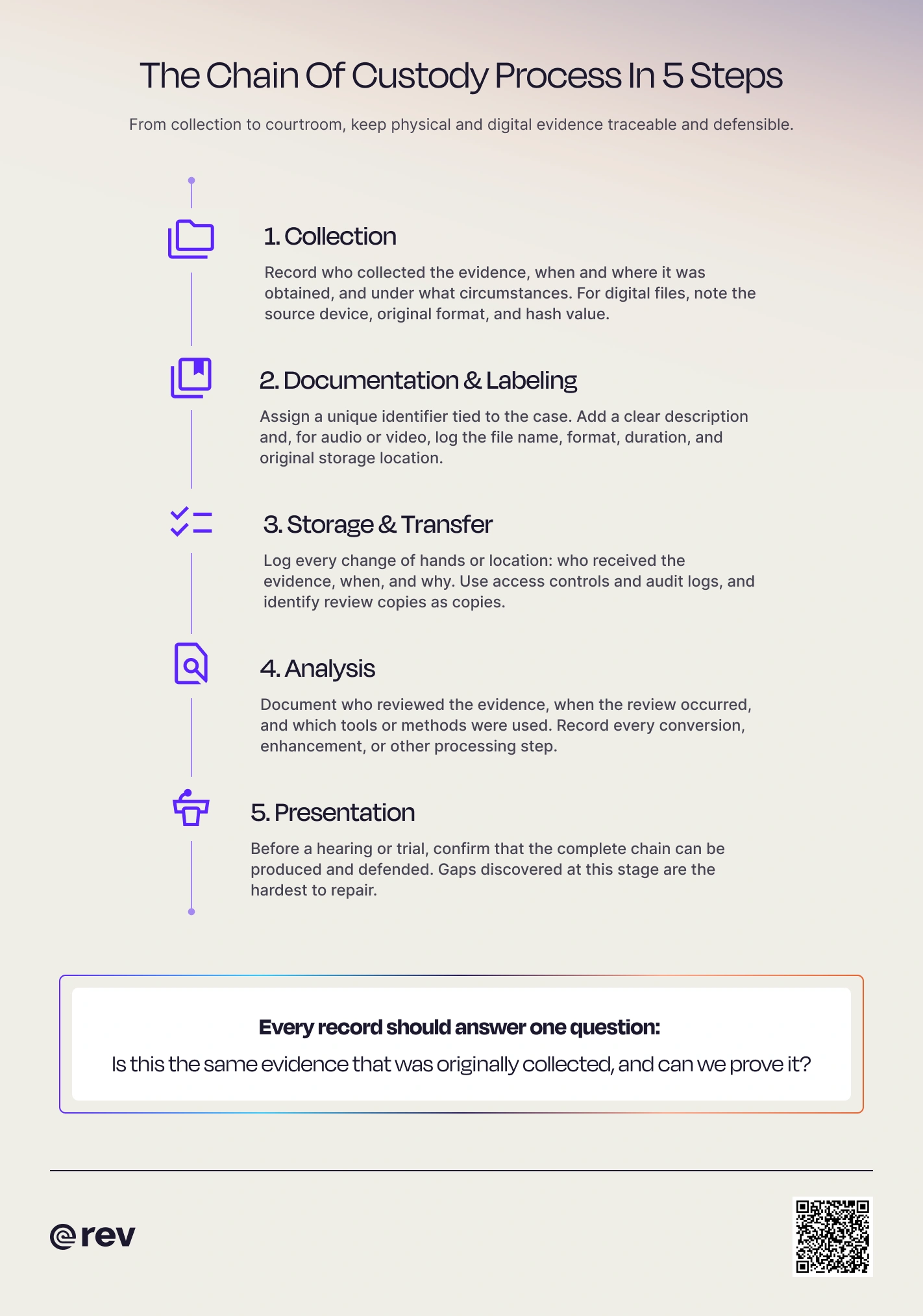
4. Analysis
Whoever reviews or analyzes the evidence documents what they did, when, and what tools or methods they used. This is especially important for digital evidence, where an analyst opening or converting a file can leave a footprint if it isn't handled carefully.
5. Presentation
By the time evidence reaches a hearing or trial, the full chain needs to be ready to produce and defend. Gaps discovered at this stage are the hardest to fix.
Going Digital With Your Evidence Chain
Manual chain of custody logs — sign-out sheets, spreadsheets, sticky notes — weren't built for the volume of digital evidence coming through most departments and firms today. Every additional body cam file, jail call, or surveillance clip is another item that needs its own documented trail, and manual tracking is where gaps creep in (see Lorraine v. Markel Am. ins. Co to learn more about how this chain could make or break your case).
Technology helps close that gap in a few specific ways. Automated logging can timestamp every access and transfer without relying on someone to fill out a form. Hash verification confirms a file is identical to the original when it's opened or shared. And a searchable, centralized record means nobody has to reconstruct history from memory when a defense attorney or judge asks who touched a file and when.
This is where Rev's Investigative Platform fits into the picture. Every recording processed through Rev is tied to the original source file and timestamp, so findings pulled from hours of body cam footage, jail calls, or interviews stay traceable back to the exact moment they came from — not a summary someone has to take on faith.
Evidence stays in a closed-loop environment, with zero data sharing with third-party models, so the chain of custody isn't compromised by the tools used to review it. And with human reviewers available when precision is non-negotiable, teams get a second layer of verification built in, not bolted on.
Keep Your Evidence Defensible From Day One
Chain of custody isn't the most exciting part of an investigation, but it's often the part that decides whether the rest of the work holds up. The good news: it gets a lot more manageable when the tools you're using are built to document the trail automatically instead of leaving it to memory and paperwork.
Rev helps investigators, prosecutors, and defense teams keep evidence organized, searchable, and traceable from the moment it's collected. Click below to see what a purpose-built platform can do.

.webp)
%20(1).webp)
.webp)